About Guides Contacts
Bespoke · Made in London

Bay Window Seats with Storage

Designed for the exact geometry of your bay, our bespoke window seats turn an under-used architectural feature into the most-used corner of the room. Concealed drawers or hinged-lid compartments give you genuine storage; the seat itself is drawn as part of the architecture.

Bravo London designs, manufactures and installs bespoke bay window seats for homeowners, interior designers and property developers across London — with a free design visit, itemised quotation and 10-year workmanship guarantee.

Transform Your Space Discuss Your Bay
Made to Measure
Every bay templated to millimetre
Designed in London
NW10 workshop, since 2009
Installed by Bravo
Professional site fitting
10-Year Guarantee
Workmanship, in writing
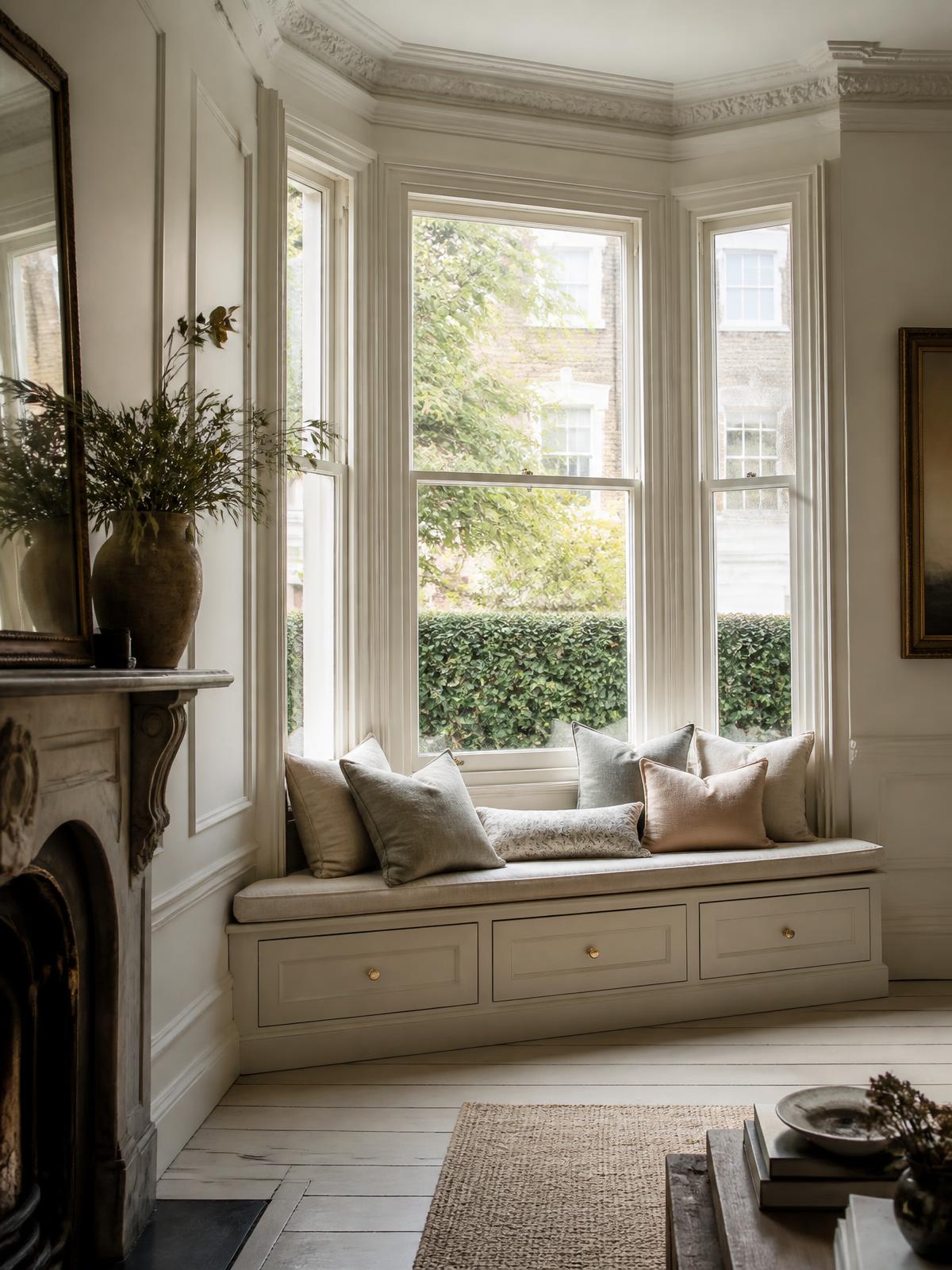
Bespoke bay window seat with drawer storage in a hand-painted off-white finish, fitted into a period London reception room with sash windows and cornicing
01 — Bay Window Seats

A bay is an architectural gift. Fitted joinery unlocks it.

London bays are one of the most distinctive features of Victorian, Edwardian and Georgian housing stock — and one of the least resolved. Freestanding furniture cannot follow its angles. There is a chair pushed into the reveal that blocks the light. They are completely hidden by a sofa in front of them. The bay becomes wasted volume in the room which arguably has the most architectural potential.

A bespoke window seat treats the bay as it was designed to be treated: as a place to sit, look out and be still. The bay's entire footprint can be used for books, blankets, toys, appliances, files and seasonal miscellany that would otherwise end up in cupboards elsewhere in the house.

Every seat we make is drawn for one specific bay. Angles, sash cord positions, radiator locations and skirting details are all templated on site before manufacture, so the finished piece sits flush with the architecture rather than being pushed into it.

  • · Square, angled and curved bays
  • · Drawer or hinged-lid storage
  • · Hand-painted or timber finishes
  • · Bespoke cushions in your fabric
  • · Flanking bookcases and cupboards
  • · Radiator relocation coordinated
  • · Listed-property sympathetic details
  • · Professional London installation
02 — The Principle

What makes a bay window seat "bespoke"?

A bespoke bay window seat is drawn, made and installed for one specific bay. Nothing is standard. The internal angles of the bay are measured on site — most Victorian bays are close to but rarely exactly 45 degrees — and each carcass segment is cut in the workshop to match. Fronts, cushion, cornice and skirting details are designed together so the finished piece reads as an original feature of the room.

The alternative — a freestanding bench pushed into the bay — never fits properly. The angles fight, the sides gap, the storage arrangement is fixed by the manufacturer rather than by your actual belongings. And crucially, it moves. A fitted seat becomes part of the architecture; it does not slide, tip, or need to be pulled out to sweep behind.

Because it is made for the room, a bespoke seat can meet uneven plaster, historic skirting and out-of-square windows cleanly. We scribe and fill on site, spray-finish in the workshop, and coordinate cushion manufacture in parallel so the finished project arrives as a single, resolved installation.

Freestanding Bench

Movable and quick to buy, but rarely follows the bay's angles, wastes the reveals and offers only fixed storage.

Modular Cabinets

Off-the-shelf carcasses combined together — better than a freestanding piece, but gapped ends and mismatched angles are almost always the finished result.

Fully Bespoke Fitted

Templated to the bay, made in one workshop, installed as one piece. No wasted volume, no forced compromise between the seat, the storage and the room.

03 — Design Options

Window seats for every kind of bay.

01

Square Bay Window Seats

A square or box bay projects straight out from the wall with two right-angle returns. The seat is a straightforward rectangular composition, usually with a bank of three or four drawers on the front elevation and full-width cushion above. Ideal for Edwardian terraces and mid-century houses where the bay is generous but simple in plan.

02

Angled Bay Window Seats

The most common London bay. Three windows set at soft angles across the front elevation, typical of Victorian terraces from Barnsbury to Balham. Each front panel is drawn to match the exact internal angle, with the storage split into three sections and drawer widths sized to the corresponding window above.

03

Curved Bay Window Seats

Georgian and Regency bows sweep as a continuous curve rather than discrete facets. Fronts are constructed from segmented components and finished so the eye reads a single flowing line. Curved seats need more workshop time but give the most architecturally pleasing finished result in the right property.

04

Reception and Living Room Seats

In reception rooms the bay usually sits behind the sofa, at the front of the house. A window seat here brings a reading corner into the room, adds occasional seating for guests, and gives you deep drawers for throws, board games, remote controls and the accumulated debris of family life.

05

Bedroom Bay Window Seats

In principal bedrooms the bay becomes a dressing area, a reading nook or an occasional seat by the window. Storage below is planned for out-of-season clothing, extra bedding or shoes. Flanking joinery often continues the composition into fitted wardrobes or bedside cupboards.

06

Kitchen Breakfast Nooks

A bay off the kitchen becomes a breakfast nook: bench seating on one or two sides of a bespoke table, with deep storage below for large appliances, table linen, wine or cookware. Cushion fabrics are chosen with performance and cleanability in mind; finishes match the surrounding cabinetry.

07

Dining Room Window Seats

Bench seating on one side of the dining table lets you seat two extra guests without the visual weight of another chair, and pulls the table closer to the window on light-restricted London plots. Storage below hides candles, table linen, serving pieces and formal dinnerware.

08

Children's Rooms and Playrooms

In children's bedrooms and playrooms the bay becomes a reading corner with deep toy storage below. Drawer fronts are sized for small hands; soft-close runners prevent trapped fingers; the cushion is specified in a washable performance fabric. Flanking bookcases complete a proper reading nook.

09

Home Office Window Seats

A short seat in a home office bay gives you a place to move to when you are on the phone or reading a document away from the screen. Concealed drawers store files, notebooks and stationery; a power outlet can be built discreetly into the front so the seat doubles as a laptop perch.

10

Hall and Landing Window Seats

A bay on a half-landing or wide hall becomes a place to pause on the way through the house. Shoe storage below is a natural specification; lift-up lids or a mix of shoe-height drawers and hinged compartments for kit bags and outdoor gear turn the seat into a properly useful piece of hallway furniture.

04 — The Storage

Drawers, hinged lids or both — planned around what you actually own.

The single biggest specification decision on a bay window seat is how the storage is accessed. Drawers on soft-close runners are the most practical everyday solution: you do not have to lift cushions or move the person sitting on the seat to reach what is inside. They are ideal for anything you touch weekly — shoes, files, paperwork, toys, board games, table linen.

Hinged lids give you a much larger single volume, useful for bulky items — spare duvets, sports equipment, seasonal decorations — that you only reach for a few times a year. Modern gas-strut lifters hold the lid open at any angle and lower it slowly under its own weight, so the mechanism is safe even in a children's room.

Many of our clients specify a mix: two or three drawers along the main run for daily use, with a hinged section at one end for deeper long-term storage. During the design visit we go through what you actually own so the storage is planned around your belongings rather than an idealised list.

Drawers

Best for everyday items. Full-extension soft-close runners; drawer boxes in birch ply or solid oak; internal dividers on request.

Hinged Lids

Best for bulky, occasional-access items. Gas-strut lifters, safety-catch hardware, lined interiors for bedding and textiles.

Combination

The most popular specification. Daily-use drawers along the main elevation with a hinged bank at one end for larger items.

05 — Recent Projects

A selection of bay window seats from our London workshop.

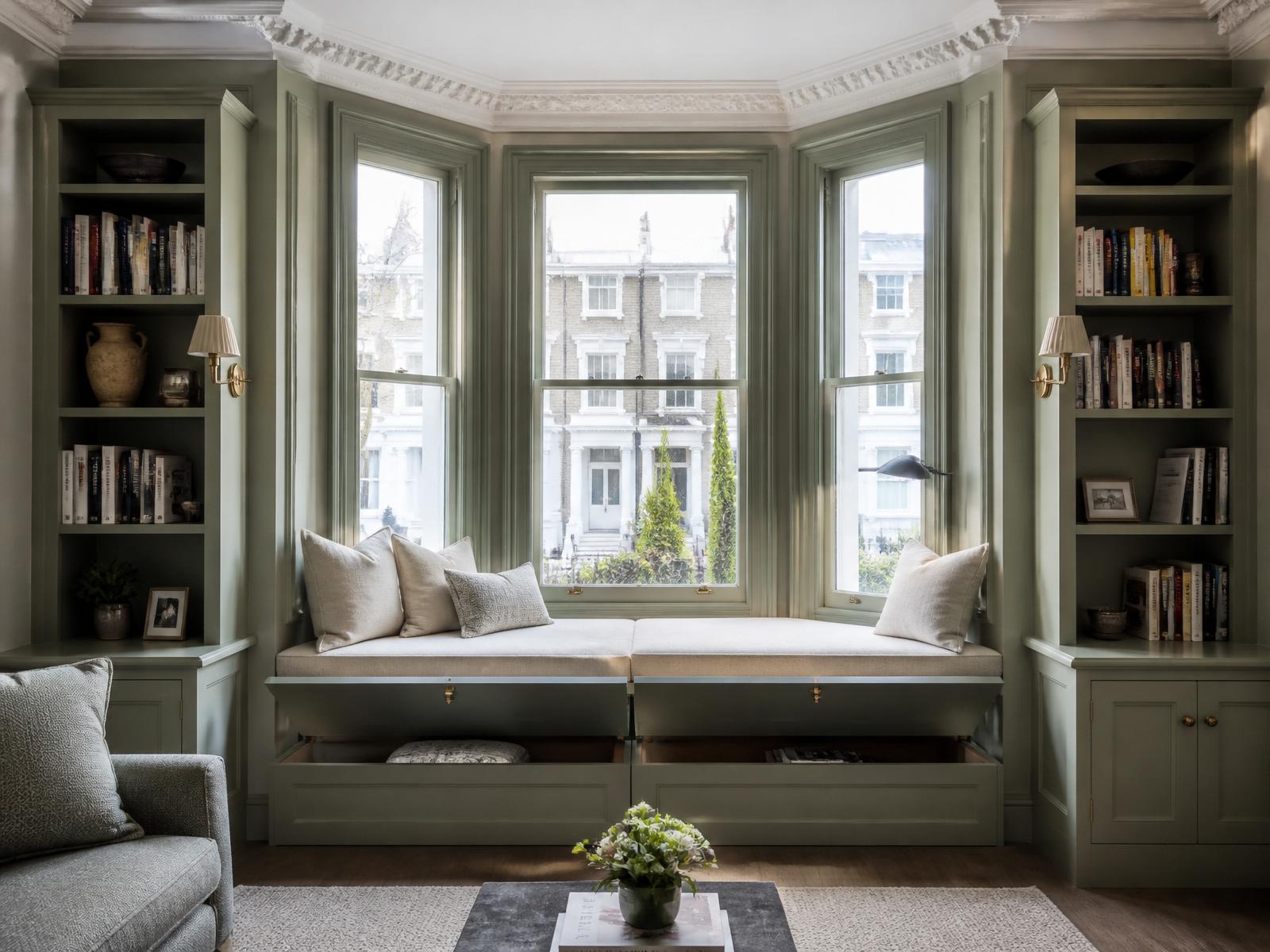
Bespoke bay window seat painted in soft sage green, with hinged-lid storage and flanking book-lined alcoves in a Chelsea reception room
Project 01 — Chelsea, SW3Angled Victorian bay, sage green hand-painted, hinged-lid storage with flanking alcove bookcases.
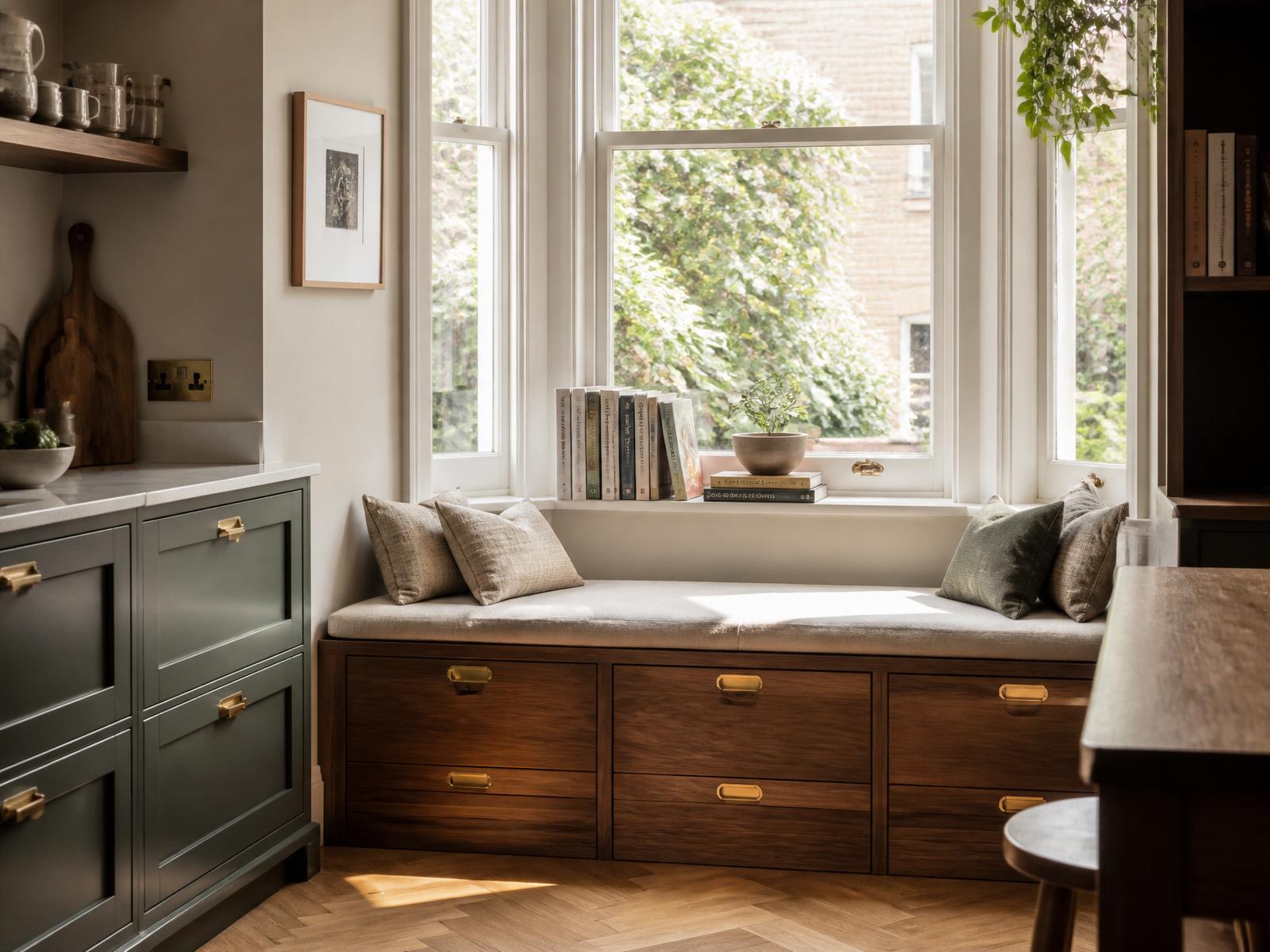
Bespoke walnut bay window seat with brass finger-pulls and drawer storage in an Islington kitchen
Project 02 — Islington, N1American walnut kitchen breakfast nook, six-drawer configuration, integrated brass hardware.
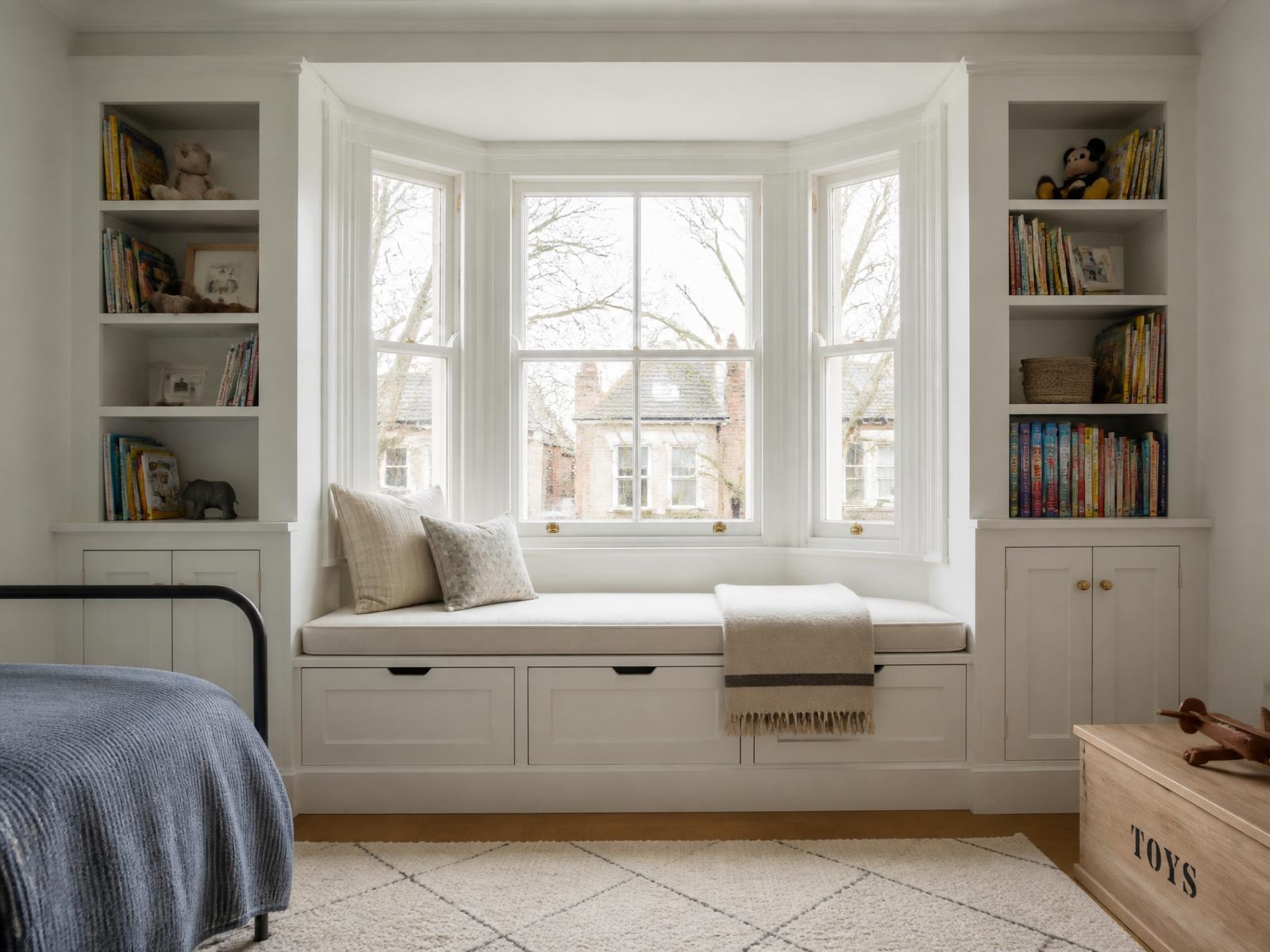
Bespoke children's bedroom bay window seat with reading nook cushion, toy-storage drawers and built-in bookshelves in a Hampstead family home
Project 03 — Hampstead, NW3Children's bedroom reading nook, chalk-white finish, toy-storage drawers with book-lined flanks.
06 — Finishes & Materials

Painted, veneered or solid timber — sprayed in our workshop.

Hand-Painted

Any RAL, Farrow & Ball, Little Greene, Paint & Paper Library or Edward Bulmer colour, sprayed in our NW10 workshop for a factory-quality finish. Grain-filled MDF for painted work; solid tulipwood for exposed edges and mouldings.

The most versatile finish and the closest match to period joinery.

Natural Timber

European oak, American walnut, ash and stained tulipwood. Veneered fronts on stable substrates with solid timber lippings and edges. Finished with hardwax oil, matt lacquer or an open-pore satin as the project requires.

Best when the seat is a stand-alone feature or ties into other timber joinery.

Cushion Fabrics

Linens, wools, velvets, boucles and performance textiles from British and European mills. Cushions are made with high-density foam wrapped in feather for comfort, finished with piped, boxed or knife-edge construction.

Removable covers wherever the fabric allows, so cleaning is straightforward.

07 — Our Process

From first visit to installed seat — six clear stages.

01

Free Design Visit

A designer visits your home to see the bay in context. We take photographs and initial dimensions, discuss the storage you actually need, and talk through the finishes and cushion options that would suit the room. There is no charge and no obligation.

02

Drawings and Itemised Quote

Within a week or two you receive a scaled drawing pack — plan, elevations and key sections — together with a written, itemised quotation. Cabinetry, cushion, delivery and installation are separated so you can see exactly where the budget sits.

03

Site Template

Once the design is agreed and deposit paid, we return to template the bay in detail: exact internal angles, sash cord positions, radiator locations, skirting profiles. Nothing is manufactured until the template is signed off.

04

Workshop Manufacture

Carcasses, drawer boxes and fronts are cut, assembled, sprayed and cushioned in our NW10 workshop. Manufacture typically takes three to five weeks depending on finish and complexity.

05

Installation

Our installation team fits the seat on site over one to two days, scribing to the room, coordinating with any plumbing or electrical works, and protecting existing floors, decorations and shutters throughout.

06

Handover and Guarantee

On completion we walk you through the finished piece, hand over care instructions for the cushion and cabinetry, and issue the written 10-year workmanship guarantee.

08 — London Specialists

Every London bay is a little different. We know most of them.

Bravo London has been designing and installing bespoke joinery from our NW10 workshop since 2009. We work across every London borough: Kensington and Chelsea, Westminster, Islington, Camden, Hackney, Wandsworth, Richmond, Barnet and beyond. Our design visits regularly cover the Home Counties too — St Albans, Guildford, Reigate, Sevenoaks and further afield on request.

Because we have been fitting seats into London bays for over a decade, we recognise most of the standard house types before we arrive: the Islington Victorian angled bay, the Chelsea Georgian bow, the Edwardian square bay in Ealing, the mansion-block square bay in Marylebone. That experience means the first design visit normally lands very close to the final specification.

Our installation teams are used to working in listed properties, mansion blocks and portered developments, with full insurances, RAMS documentation, floor protection and out-of-hours access arranged as required.

09 — Frequently Asked

Bay window seats with storage — your questions, answered.

What is a bay window seat with storage?
A bay window seat is a made-to-measure bench fitted into the shape of a bay. The base can be designed with drawers, cupboards or lift-up compartments, turning otherwise awkward floor space into comfortable seating and useful storage.
Do bay window seats add value to a London home?
A well-designed window seat can make a room feel more considered and provide valuable built-in storage, which is especially useful in London homes. Its effect on resale value varies, but good-quality fitted joinery can improve both everyday usability and buyer appeal.
Should I choose drawers or a hinged lid for the storage?
Drawers are convenient for items you use regularly because the cushion can stay in place. A hinged lid usually offers one larger compartment and can make better use of deep or irregular spaces. The best option depends on the bay shape, access and what you plan to store.
Can a bay window seat be built into an angled or curved bay?
Yes. Bespoke joinery can be scribed to angled walls, shallow facets and curved bays. A detailed site measure is used to create a seat that follows the architecture while allowing for window operation, ventilation and access where needed.
How much does a bespoke bay window seat with storage cost?
Cost depends on the bay dimensions, storage layout, materials, finish, cushion specification and installation requirements. A measured design and itemised quotation are the most reliable way to price the work accurately.
Do you make the cushion as well as the seat?
Yes. The cushion can be made to fit the finished seat precisely, with a choice of foam firmness, edge profile and upholstery fabric. Removable, zipped covers are usually the most practical option for cleaning and long-term care.
Can a bay window seat sit over a radiator?
It can, provided the design allows heat to circulate safely. Ventilation grilles, an open plinth or discreet airflow gaps may be required, and valves should remain accessible. The radiator type and output should be reviewed before the seat is finalised.
Will a bay window seat block the radiator or the sash cords?
A properly surveyed seat should be designed around both. Airflow routes can be incorporated for the radiator, while removable panels or carefully positioned clearances can preserve access to sash pockets, cords, weights and window hardware.
Can you build a window seat around existing skirting and architraves?
Yes. The joinery can be scribed around existing mouldings or detailed so the new work appears to continue them. Where appropriate, sections may be carefully removed and reinstated to create a cleaner, more integrated finish.
How deep should a bay window seat be?
A comfortable finished seat is commonly around 450–550 mm deep, although the right dimension depends on the bay, cushion thickness and intended use. A reading seat may be deeper, while a dining bench is often kept more upright and compact.
Can a bay window seat include integrated lighting or power?
Yes. Reading lights, concealed LED strips, sockets and USB charging points can be planned into the design. Electrical work should be coordinated early and completed by a suitably qualified electrician, with cables and access points kept serviceable.
How long does design, manufacture and installation take?
The programme varies with design complexity, finish, fabric lead times and workshop capacity. After survey and design approval, manufacture usually takes several weeks, followed by installation and any final decorating or upholstery work.
Do bay window seats work in kitchens and dining rooms?
Yes. They can create efficient banquette seating around a dining table and add storage for tableware, linens or occasional kitchen items. Seat height, back support and table clearance should be designed together for comfortable dining.
Can a window seat be combined with fitted bookcases or cupboards?
Yes. A window seat can form the centre of a larger fitted composition with bookcases, display shelves, cupboards or media storage on either side. Matching proportions, mouldings and finishes helps the whole elevation feel intentional.
What finishes are available for a bay window seat?
Options include hand-painted or spray-painted finishes, clear lacquer, stained timber and natural oil, depending on the chosen material. Colour, sheen level and detailing can be matched to existing joinery or used to create a deliberate contrast.
Can you build a window seat in a listed building?
It may be possible, but the design must respect the building’s historic fabric and any consent requirements. Reversible fixing methods, careful scribing and minimal alteration to original joinery are often important. Listed building advice should be obtained before work begins.
Do you install bay window seats in flats and leaseholds?
Yes, subject to access and any building rules. Leaseholders may need written consent for alterations, and installation planning should account for lifts, stairways, parking, working hours and protection of communal areas.
How is the cushion cleaned and maintained?
Regular vacuuming with an upholstery attachment helps prevent dust build-up. Removable covers should be cleaned according to the fabric manufacturer’s instructions, and spills should be blotted promptly rather than rubbed. Rotating loose cushions can also help them wear evenly.
Do you offer a guarantee on your window seats?
Guarantee terms should be confirmed in the project proposal and may differ between the joinery, hardware, finish, upholstery and electrical components. The written quotation should explain what is covered, for how long and any maintenance conditions.
Do you work with interior designers and architects?
Yes. The joinery can be developed from an existing design package or collaboratively from concept stage. Clear drawings, finish samples, dimensions and coordination with other trades help ensure the finished seat fits the wider interior scheme.

10 — Book a Design Visit

Turn your bay into the best-used corner of the room.

Tell us a little about your bay and we'll be in touch to arrange a free design visit. Most of our clients are called back within one working day.


Bravo London Ltd — Unit 5, The Chase Centre, 8 Chase Road, NW10 6QD
020 8965 5680 · hello@bravolondon.co.uk